
REVIEW · BEIRUT CITY TOURS & WALKS
Guided Half-Day Private Beirut Historical Tour
Beirut in five hours makes you smarter fast. This private historical tour is a strong way to get your bearings quickly, with a guide who gives context as you move across downtown and the coast. I especially like the mix of must-see monuments plus everyday places like the Beirut Souks and seaside promenades, all wrapped into one smooth route. One thing to consider, the National Museum of Beirut admission is not included, so you may want to plan for that extra cost.
What makes this work for real travel days is the logistics. You get front-door hotel pickup and drop-off, then an air-conditioned vehicle that keeps the whole thing comfortable. I also like that it feels more like a guided day with choices for what to explore next, not a rushed checklist.
The downside is simple: it is a half-day. You will see a lot, but you will not have long, slow time at every single stop, so if you want deep museum time or long photo breaks, you might feel a bit timed.
In This Review
- Key highlights worth your attention
- The value of a 5-hour private Beirut orientation
- Hotel pickup, air-conditioned vehicle, and a smooth city route
- National Museum of Beirut: the best “why it all matters” stop
- Roman Baths in downtown Beirut, then Martyr’s Square
- Mohammad Al-Amin Mosque and Al-Omari Mosque: Beirut’s faith map in minutes
- Greek Orthodox Cathedral of Saint George: one of the oldest church sites
- Place de l’Etoile, Beirut Parliament area, and the iconic clock
- Beirut Souks, Zaytouna Bay, and the Corniche shoreline payoff
- Raouche Pigeon Rocks: the classic viewpoint moment
- The abandoned Holiday Inn hotel: a hard stop with context
- Who should book this half-day private tour
- Price, inclusions, and what you should budget
- Small practical tips so the half-day feels good
- Should you book it? My honest take
- FAQ
- How long is the guided half-day tour?
- What is included in the price?
- Is admission included for the National Museum of Beirut?
- Which stops have free admission?
- Does this tour have hotel pickup and drop-off?
- Is it a private tour?
- What if my plans change, can I cancel for a refund?
Key highlights worth your attention
- Front-door pickup and drop-off mean you spend less time figuring out routes and more time seeing sights.
- A private guide turns famous locations into a story, especially around Lebanon’s layered history.
- Major free stops keep the trip affordable beyond the museum.
- Downtown to the coast coverage helps you understand Beirut’s geography in one go.
- A war landmark stop adds weight and context you will not get from photos alone.
Other walks around Beirut we have reviewed
- PRIVATE Beirut Historical Walking Half Day Tour★ 5.0 · 27 reviews
- Historical Beirut Tour (AM) Half Day – (4G on Board)★ 4.0 · 16 reviews
- Beirut Full Day Walking Tour★ 5.0 · 14 reviews
- Pigeon Rocks Boat Ride Beirut (Raouche Rocks)★ 5.0 · 10 reviews
The value of a 5-hour private Beirut orientation
Beirut can feel like a maze when you are on your own. Roads, neighborhoods, and sights can be spread out, and the clock matters if you only have a short window. This tour solves that problem by doing the heavy lifting for you, with a private group and a set route designed for highlights in about five hours.
At $75 per person, the math works best when you add up convenience and guide time. You are not just paying for transport. You are paying for a guided storyline that helps you connect what you see at the National Museum to what you notice later at mosques, churches, squares, and the waterfront.
You also get some practical bonuses that are easy to overlook until you need them. Hotel pickup and drop-off reduce hassle. The air-conditioned vehicle helps, especially when the day is warm. And because this is private, the experience is tailored to your group schedule, not a fixed crowd flow.
Hotel pickup, air-conditioned vehicle, and a smooth city route
The tour starts with pickup from your hotel and ends with drop-off back at your start point. That matters in Beirut, where spending time to navigate between downtown landmarks can steal energy you could use for sightseeing.
Once you are in the car, you move efficiently across the city center and toward the sea. That means you spend your limited time where it counts, at landmarks and viewpoints, rather than stalled at intersections or trying to coordinate transit.
This is also the kind of setup that helps you take photos without stress. You are not sprinting between far-apart stops. You can keep your gear ready and still stay calm.
National Museum of Beirut: the best “why it all matters” stop
Your first major stop is the National Museum of Beirut, the principal archaeology museum in Lebanon. The tour frames it as an overview of Lebanon’s history and the civilizations that shaped the country at a cultural crossroads.
This is the one stop where you should expect the timeline to stretch. You have about two hours here, which is long enough to get a sense of scale and theme, even if you do not read every label. The museum holds a large collection of priceless artifacts from across Lebanon, with excavations spanning the country.
One key point for your planning: admission tickets are not included. So if you are trying to budget tightly, factor in museum entry before you go.
Even if you are not a museum person, this stop pays off. Later, when you see Roman Baths, mosques, and churches, the museum gives you context for why these places feel connected. It also makes your city walk more meaningful, because you understand what layers you are standing on.
Guided departures across Lebanon we have looked at
Roman Baths in downtown Beirut, then Martyr’s Square
Next you head to the Roman Baths, the Roman Berytus baths. This is the largest outdoor sight in downtown Beirut. The facts are striking even before you look closely: they were discovered in 1968 to 1969 and renovated in the mid 1990s.
You will be able to see how the Baths reflect ancient traditions of the site today. One of the bath areas is used as an artistic performance and concert space, which is a neat reminder that old spaces can still have a modern role.
The tour keeps the time tight here, with about 15 minutes. That is enough for getting your bearings and spotting the essentials, but if you love Roman architecture, you might wish you had longer. Still, for a half-day route, it is a good match.
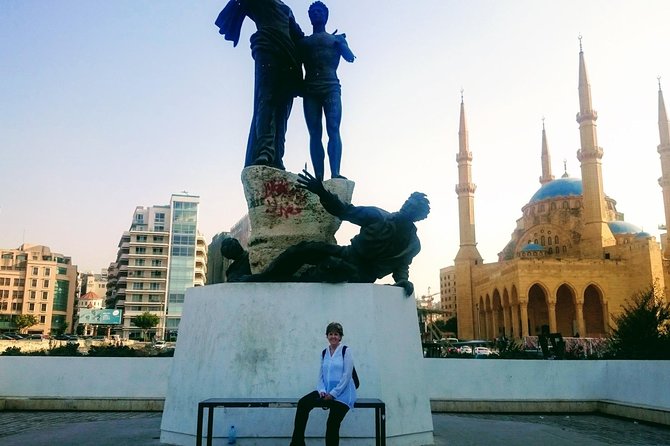
Then you shift from ancient ruins to World War I memory at Martyr’s Square. It is the heart of downtown Beirut and it has another historical name, Al Burj or Place des Cannons. The square is named after the execution of Lebanese nationalists on 6 May 1916 ordered during World War I.
This stop is free and brief, around 15 minutes, but it lands emotionally. It gives you a clearer sense of how Beirut’s public spaces carry political and historical weight.
Mohammad Al-Amin Mosque and Al-Omari Mosque: Beirut’s faith map in minutes
The tour moves next into Beirut’s religious architecture, and it does it in a way that helps you compare eras and styles quickly.
First is Mohammad Al-Amin Mosque, also called the Blue Mosque. The tour notes it as the biggest mosque in Lebanon, opened in 2008 and located near Martyr’s Square. You get a quick visual sweep with four minarets reaching 65m high, plus multiple domes.
The description you are likely to notice on the ground is the light blue tile domes, plus the multi-story arches. The time here is about 10 minutes, and that is just enough to appreciate the scale and color without rushing.
After that comes Al-Omari Mosque, the Al-Omari Grand Mosque. The story is layered: built in the age of Omar Bin El Khattab in 635 AD, converted to a church by the crusaders in the 12th century, then retransformed into a grand mosque by the Mamluks in 1291. It was damaged during the Civil War, and refurbishment was completed in 2004.
This one is also free and around 10 minutes, so you cannot fully trace every era on site. Still, the quick stop makes a bigger point: in Beirut, sacred spaces can change roles over centuries.
Greek Orthodox Cathedral of Saint George: one of the oldest church sites
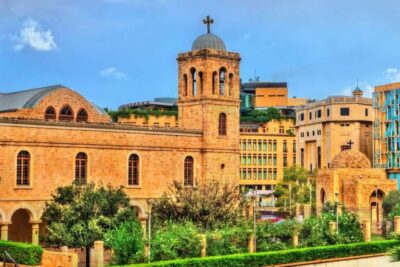
Your next church stop is the Greek Orthodox Cathedral of Saint George. This is described as the seat of the Greek Orthodox Metropolitan bishop of Beirut. It is also identified as the oldest church in the city of Beirut and among the oldest in the region.
The tour points out that the first Christian temple on this location dates back to the mid-sixth century AD, and it is closely associated with Beirut’s famous Law School. Even if you only take a few minutes here, this connection to an educational institution gives the site extra meaning.
Like the other faith stops, admission is free and the time is about 10 minutes. For me, that is the right pace inside a dense city center. You want to see and orient yourself, then keep moving so the rest of the route stays enjoyable.
Place de l’Etoile, Beirut Parliament area, and the iconic clock
The route then reaches Place de l’Etoile (also known as Nejme Square). This is the central square in the Downtown area and it is tied directly to government and major institutions, including the Lebanese Parliament and complementary buildings.
The stop is about 15 minutes and free. What makes it memorable is the architecture and the landmark detail: a four-faced Rolex clock built in 1930.
This is one of those moments where you can pause, look around, and feel how Beirut assembles modern civic life with older urban design. It also gives you a natural transition point, because you are ready for the more casual city energy that comes next.
Beirut Souks, Zaytouna Bay, and the Corniche shoreline payoff
After the downtown square, you get a full day-to-day flavor break with Beirut Souks. The tour describes it as a commercial district with over 200 shops and about 25 restaurants and cafes, plus entertainment and a cinema complex. It is also presented as the largest and most diverse shopping and leisure area in Beirut.
You only spend about 15 minutes here, but that is enough time to get a feel for the vibe and decide whether it is a good place to return later. If you want souvenirs or a casual meal option, this stop helps you spot where the action is.
Then the route shifts to the waterfront with Zaytouna Bay, a newer promenade with shops and restaurants. The tour frames it as Beirut’s finest leisure destination. Again, the stop is short, around 10 minutes, but it is a helpful way to see where people go when they want a break from city streets.
From there you move onto the Corniche Beirut. This is the renowned seaside promenade, stretching from the Ramlet al Bayda area to Saint George marina, lined with palm trees. You get views of the Mediterranean Sea and of Mount Lebanon’s summits on the eastern side. This is about 15 minutes, and it is one of the best moments for photos because you are naturally positioned for open views.
Raouche Pigeon Rocks: the classic viewpoint moment
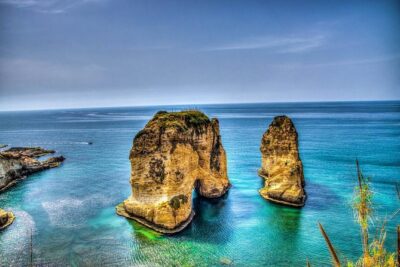
The final set of sights brings you to Pigeon Rocks in Raouche. The tour calls it a stunning set of rocks and a popular tourist destination known for iconic rock formations in seaside surrounds.
The rock formations are described as two huge sentinels at Beirut’s western-most tip. You will get about 15 minutes here, free, which is usually just long enough to take your photos, enjoy the sea air, and understand why this spot is a symbol for the city.
If you are sensitive to heat or sun, this is a good place to plan your timing. Short breaks between stops can keep the day comfortable.
The abandoned Holiday Inn hotel: a hard stop with context
The most emotionally heavy part of the itinerary is the abandoned Holiday Inn Hotel, a war landmark. The tour notes it was built between 1971 and 1974 during a period when Beirut’s economy was booming and the city was one of the most visited tourist destinations in the Middle East.
The hotel functioned until the Lebanese Civil War began in 1975. After that, it was considered a war zone for a long time, known as the Battle of the Hotels, where more than 25,000 combatants fought for control over luxury hotels, including the Holiday Inn and the famous Phoenicia hotel.
Today, the Holiday Inn remains untouched and abandoned for decades, acting as a reminder of the horrors of war for Lebanon’s population.
This stop is not listed with a timed duration in your notes, but it is clearly one you should approach with care. It is not just a photo stop. It is the kind of location where your guide’s context can make the difference between seeing ruins and truly understanding why they matter.
Who should book this half-day private tour
This tour fits best if you want to get oriented quickly and learn the story behind key sites, without spending your whole day in transit.
You should consider booking if:
- You have limited time in Beirut and want an efficient route.
- You prefer a private guide who can add context as you go.
- You want both history stops and city-life stops like the Souks and Zaytouna Bay.
- You like the idea of ending with seaside views and classic landmarks.
It likely also suits many people because the experience notes that most travelers can participate. Still, if you know you need long rests, mobility time, or extended museum time, plan for the half-day structure.
Price, inclusions, and what you should budget
At $75 per person, you are paying for a private guided route with hotel pickup and drop-off, plus comfortable private transportation and an air-conditioned vehicle.
A big reason the price feels reasonable is that many stops are free. The Roman Baths, Martyr’s Square, Mohammad Al-Amin Mosque, Al-Omari Mosque, the Greek Orthodox Cathedral of Saint George, Place de l’Etoile, Beirut Souks, Zaytouna Bay, Corniche Beirut, and Pigeon Rocks are listed as free admission.
The one clear cost to plan for is the National Museum of Beirut admission, which is not included. Lunch is also not included, so you will need to handle food either before or after the tour.
If you want value, bring a simple plan: quick snack before the museum, then a proper meal afterward, when you can take your time.
Small practical tips so the half-day feels good
For a short tour, your comfort matters more than usual. Here are a few practical moves based on how the day is structured:
- Wear comfortable walking shoes, because even short stops add up across downtown streets.
- Bring water, since you will have waterfront time and outdoor viewing at the Roman Baths and Pigeon Rocks.
- If you care about photos, keep your camera ready for the Corniche and the rock formations at Raouche.
- When you enter religious buildings, follow the local norms for respectful dress and behavior, since these are active sacred spaces.
The tour is built for pace. The better you prepare, the more you will enjoy that pace instead of feeling rushed.
Should you book it? My honest take
I think this is a smart choice for a first visit to Beirut, especially when your time is tight. You get a private guide telling the story behind the places, you cover both downtown and the sea, and you end with a sense of what to return to later. That blend is exactly what helps the day feel useful, not just busy.
Book it if you want orientation, context, and a mix of history and modern city life in one compact schedule. Skip it or adjust your expectations if you want long, slow time in any one place. This route is about seeing a lot with meaning, not about lingering.
FAQ
How long is the guided half-day tour?
The tour runs for about 5 hours.
What is included in the price?
It includes hotel pick up and drop off, a comfortable private vehicle, professional guides, air-conditioned transportation, and local authentic experiences. Lunch is not included.
Is admission included for the National Museum of Beirut?
No. Admission for the National Museum of Beirut is not included.
Which stops have free admission?
The Roman Baths, Martyr’s Square, Mohammad Al-Amin Mosque, Al-Omari Mosque, Greek Orthodox Cathedral of Saint George, Place de l’Etoile, Beirut Souks, Zaytouna Bay, Corniche Beirut, and Pigeon Rocks are listed as free.
Does this tour have hotel pickup and drop-off?
Yes. Front-door hotel pickup and drop-off are included.
Is it a private tour?
Yes. It is a private tour, so only your group participates.
What if my plans change, can I cancel for a refund?
You can cancel for a full refund if you cancel up to 24 hours in advance of the experience start time, based on local time.
More of Lebanon, Reviewed
- Guided Small-Group Tour to Baalbek, Anjar and Ksara with Lunch
★ 5.0 · 511 reviews - Guided Small-Group Tour to Jeita, Harissa, Byblos with Lunch
★ 5.0 · 361 reviews - City Sightseeing Beirut Hop-On Hop-Off Bus Tour
★ 4.5 · 87 reviews - Private Anjar and Baalbek Tour from Beirut with Departure Ticket
★ 5.0 · 79 reviews - Guided Private Full Day Tour to Baalbek, Anjar and Chateau Ksara
★ 5.0 · 60 reviews
Elsewhere in Lebanon
- Guided Small-Group Tour to Baalbek, Anjar and Ksara with Lunch
★ 5.0 · 511 reviews - Guided Small-Group Tour to Jeita, Harissa, Byblos with Lunch
★ 5.0 · 361 reviews - Paragliding Trip Over Lebanon – Jounieh Bay
★ 5.0 · 257 reviews - Jeita Grotto,Harissa&Byblos Full-Day PRIVATE-CAR Trip from Beirut
★ 5.0 · 222 reviews - First Paragliding Club in Lebanon – Since 1992
★ 5.0 · 193 reviews
Beirut on Foot
- City Sightseeing Beirut Hop-On Hop-Off Bus Tour
★ 4.5 · 87 reviews - PRIVATE Beirut Historical Walking Half Day Tour
★ 5.0 · 27 reviews - Historical Beirut Tour (AM) Half Day – (4G on Board)
★ 4.0 · 16 reviews - Beirut Full Day Walking Tour
★ 5.0 · 14 reviews - Pigeon Rocks Boat Ride Beirut (Raouche Rocks)
★ 5.0 · 10 reviews
Other Lebanon trips we have written up



Beirut City Tours & Walks, compared.
 ★ 4.5City Sightseeing Beirut Hop-On Hop-Off Bus TourFrom $2387 reviews
 ★ 5.0PRIVATE Beirut Historical Walking Half Day TourFrom $9327 reviews
 ★ 4.0Historical Beirut Tour (AM) Half Day – (4G on Board)From $5016 reviews
 ★ 5.0Beirut Full Day Walking TourFrom $4114 reviews
 ★ 4.5Private Beirut City Tour with Boat Ride at Raouche RockFrom $10810 reviews
 ★ 5.0Pigeon Rocks Boat Ride Beirut (Raouche Rocks)From $3210 reviews
 ★ 4.9Private Walking Tour With A Guide (Private tour)From $539 reviews
 ★ 5.0BEYOND BEIRUTFrom $1107 reviews
Every list this tour turns up in